
On journalistic asymmetry, geopolitical sensitivity, and historical memory
Introduction
The name Jeffrey Epstein has become synonymous with one of the biggest elite scandals of this century. The American financier, who died in 2019, possessed an exceptional network that extended into the highest circles of politics, science, and business. His arrest on charges of large-scale sexual exploitation of minors, and his subsequent death in a cell, led to worldwide speculation.
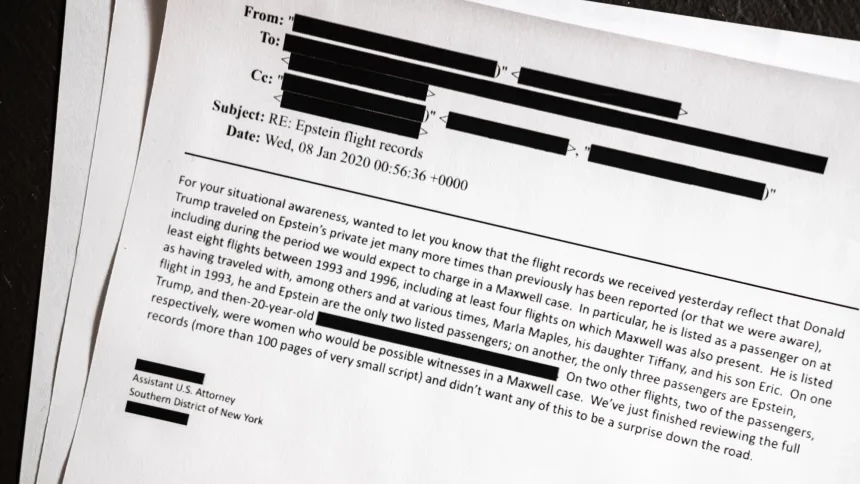
Recently released documents – including FBI memos and email correspondence – have further mapped the network surrounding Epstein. While media attention has primarily focused on American prominenti and the legal implications for the victims involved, a closer examination of the documents reveals a geopolitically sensitive dimension. A dimension that raises questions about the consistency of Western investigative journalism.
What the Documents Actually Contain
The publicly released files contain several remarkable passages. An FBI memo quotes a source claiming that Epstein was a “co-opted Mossad agent.” This is a source claim, not an established conclusion, but its presence in a federal dossier is significant in itself.
Furthermore, released emails show that former Israeli Prime Minister Ehud Barak used an apartment in Manhattan managed by Epstein. The correspondence mentions informing a contact at the Israeli consulate about who entered the property. The documents also reveal business investments between Epstein and Barak, particularly in technology companies with ties to the Israeli security sector.
This data does not constitute proof of state involvement in Epstein’s crimes. However, it does justify a thorough and consistent journalistic investigation into all international branches of his network.

Asymmetry in Media Coverage
American and European media have reported extensively and critically on Epstein’s contacts with Russian oligarchs or figures from the former Soviet bloc. Such connections invariably lead to analyses of intelligence operations and geopolitical influence.
The Israeli component in the dossiers – substantiated with documentary evidence – remains underexposed. Where Russia or China appear in files, interpretation follows immediately; when Israel appears multiple times in a sensitive context, the journalistic intensity remains notably more limited. This is not a matter of complete absence, but a striking difference in depth of investigation. And in geopolitical analysis, it is precisely this difference that is significant.
Power, Alliance, and Institutional Caution
Israel is a core ally of the United States, deeply intertwined with its defense and intelligence apparatus. It is precisely this strategic reality that makes any dossier in which Israel appears in a compromising context sensitive in Washington and European capitals.
Journalistic reticence is rarely the result of explicit instructions. It arises more from a complex interplay of factors: access to sources, reputation management, political sensitivity, and social tensions. The result is not visible censorship, but a pattern of selective intensity. And this pattern is, in itself, a relevant geopolitical given.
The International Dimension and Western Credibility
The West likes to profile itself as a normative power, founded on transparency and the rule of law. However, when the impression arises that certain states are treated with more caution than others, it undermines its own credibility.
Rival powers will actively exploit such asymmetries to frame the Western discourse on morality and law as hypocritical. Soft power – the ability to exert influence through moral authority – is vulnerable to precisely this kind of inconsistency. What is at stake here is therefore more than a legal scandal; it is the West’s moral reputational capital itself.
The European Historical Risk
For Europe, this dossier is particularly sensitive. The Holocaust is a fundamental moral reference point in the European consciousness. Precisely for this reason, it is crucial to maintain the distinction between criticism of a state and criticism of a people, and between investigating power networks and ethnic stigmatization.
When media, for fear of accusations of antisemitism, investigate certain geopolitical questions less thoroughly, a paradoxical and dangerous side effect occurs. The problem is not that Israel is being investigated, but that the appearance is created that Israel cannot be investigated. And in politics, perception is often more powerful than reality.
If citizens get the feeling that certain states are systematically shielded, distrust can shift from institutions to identities. The distinction between state power and ethnicity then blurs. This mechanism has had devastating consequences in European history. Selective journalism can, unintentionally, create a breeding ground for speculation, resentment, and old stereotypes. Those who genuinely want to combat antisemitism must therefore choose radical consistency. Equal standards for everyone offer more protection in the long term than well-intentioned reticence.
Conclusion
The documents are public. The quotes are verifiable. The question is not whether every assertion has now been proven, but whether every geopolitical lead is investigated with the same persistence.
If the West wants to maintain its moral position in the world, it cannot afford selective curiosity. Where transparency is applied unevenly, the suspicion of protection inevitably arises. And that suspicion – even if unfounded – fuels precisely what it claims to want to combat.
It is not investigation that harms trust, nor transparency that undermines security. It is asymmetry that erodes legitimacy. And without legitimacy, the West ultimately loses more than a narrative; it loses its moral authority.
Leave a Reply